In December 2026, we plan to publish new Crossref Member Practices which will set out the standards we expect all Crossref members to meet. From August to October 2026 we are consulting with our members on a draft of these Member Practices. This blog provides the background to this, and explains how you can share your views.
The Crossref community in India is as diverse as the region that it represents, comprising 1605 members, 11 sponsoring organisations, and 5 ambassadors, who between them cover the length and breadth of this country. Between November 2025 and March 2026, we organised three webinars focused on supporting this community with best metadata and publishing practices. We collaborated with the Directory of Open Access Journals (DOAJ) and the Committee on Publication Ethics (COPE) to embed understanding of metadata’s role in the greater context of publishing integrity.
PID strategies are being written around the world right now, and the decisions being made will shape the scholarly record for decades. After 25 years running open scholarly infrastructure—now on behalf of 25,000 members in 167 countries—Crossref has an informed perspective on what those decisions should ideally rest on. Today we’re setting it out in our first position paper: Persistent identifiers in research infrastructure policy: the need for a holistic approach. You can read it online or download the PDF; it’s a 16-minute read.
Research is rarely limited to a single contributor performing a single role. Behind every research output are people contributing in various ways: software development, data analyses, methodology design, and much more. Often, the same person contributes in several of these ways. Until now, Crossref metadata could only capture part of that picture, but this is changing with Schema 5.5.
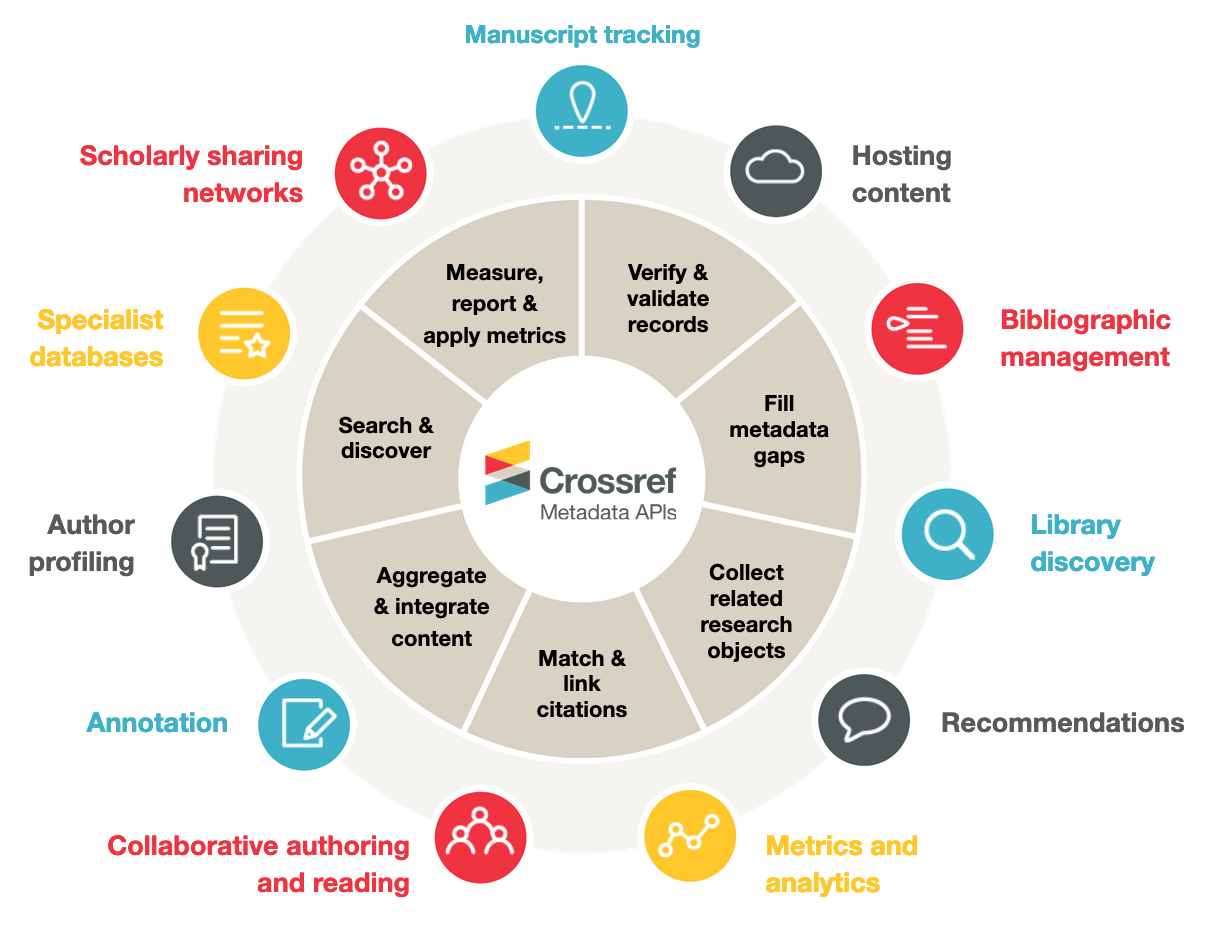
Some of the typical users (outer) and uses (inner) of Crossref metadata
People using Crossref metadata need it for all sorts of reasons including metaresearch (researchers studying research itself such as through bibliometric analyses), publishing trends (such as finding works from an individual author or reviewer), or incorporation into specific databases (such as for discovery and search or in subject-specific repositories), and many more detailed use cases.
All Crossref metadata is open and available for reuse without restriction. Our 185 million records include information about research objects like articles, grants and awards, preprints, conference papers, book chapters, datasets, and more. The information covers elements like titles, contributors, descriptions, dates, references, connecting identifiers such as Crossref DOIs, ROR IDs and ORCID iDs, together with all sorts of metadata that helps to determine provenance, trust, and reusability—such as funding, clinical trial, and license information.
Anyone can retrieve and use >185 million records without restriction. So there are no fees to use the metadata but if you really rely on it then you might like to sign up for Metadata Plus which offers greater predictability, higher rate limits, monthly data dumps in XML and JSON, and access to dedicated support from our team.
Options for retrieving metadata
All Crossref metadata is completely open and available to all. Whatever your experience with metadata, there are several tools, techniques, and support guides to help—whether you’re just beginning, exploring occasionally, or need an ongoing reliable integration.
BEGINNING?
You’ve heard Crossref metadata might be useful and want to know where to start.
We recommend you start with metadata search, funder search, or simple text query for matching references to DOIs. Also take a look at the REST API which only needs you to get a JSON plugin to view the results. We are building tutorials to demonstrate the possibilities, starting with a Python notebook and an R notebook. If it’s retractions and corrections that you need, check out the frequently-updated csv file of the Retraction Watch dataset that we acquired and opened in 2023.
EXPLORING?
You have some specific queries and want a lightweight way to use Crossref metadata.
You rely on Crossref metadata and need to incorporate it into your product at scale.
You might want to jump straight to subscribing to Metadata Plus, which is our premium service for the REST API that comes with monthly data dumps in JSON and XML, higher rate limits, and fast support. But we always recommend that you try out the public version first to make sure it will work for your product. If you’re looking for a single DOI record in multiple formats (e.g. RDF, BibTex, CSL) you can use content negotiation.
Watch the animated introduction to metadata retrieval