On behalf of the Nominating Committee, I’m pleased to share the slate of candidates for the 2026 board election. Every active member organisation is invited to submit a ballot to elect the incoming board class.
We’re providing a summary of the board’s July 2026 meeting. The July board meeting is our only in-person meeting. The board gathers for two days of strategic thinking and long-range planning, as well as conducting annual board business. This year, we focused on allocating surplus funds we have on hand to invest in a three-year project to redesign the content system. In a related discussion, we decided to lower content registration fees starting in 2027 because we’ve had a demonstrated history of generating surpluses, exceeding what we need to run Crossref. We also discussed the board structure, as part of our regular review of stakeholder governance. And we conducted annual board business, such as approving the audited financial statements and reviewed our risk register and mitigation plans.
The resolutions are available on the dedicated section of our website, which also lists the members of the Board and offers further information about our governance.
We also managed to squeeze in watching a World Cup game over dinner.
Starting today, funder names deposited in Crossref metadata without an identifier will be matched to ROR IDs, to support an open and connected Research Nexus. Funding information is an increasingly important part of the scholarly record. The improved matching strategy supports researchers, funders, institutions, and meta-researchers, who rely on that information to understand how research is supported and what outcomes that support produces.
Strengthening Scholarly Publishing in Africa is a collaborative webinar series bringing together ASSAf, Crossref, DOAJ, EIFL, and PKP to share practical guidance, resources, and approaches for strengthening the publishing ecosystem in the region. This series responds to the growing interest in open access, digital publishing, stronger editorial practices, and greater visibility of research publishing across Africa. Each partner organisation has long experience of building that capacity in the area of their expertise. In this series, we’re coming together to offer a more holistic learning experience to the community of African publishers, putting different aspects of the publishing process in their broader context.
Content Registration allows members to register and update metadata via machine or human interfaces.
When you join Crossref as a member you are issued a DOI prefix. You combine this with a suffix of your choice to create a DOI, which becomes active once registered with Crossref. Content Registration allows members to register a DOI and deposit or update its associated metadata, via machine or human interfaces.
Benefits of content registration
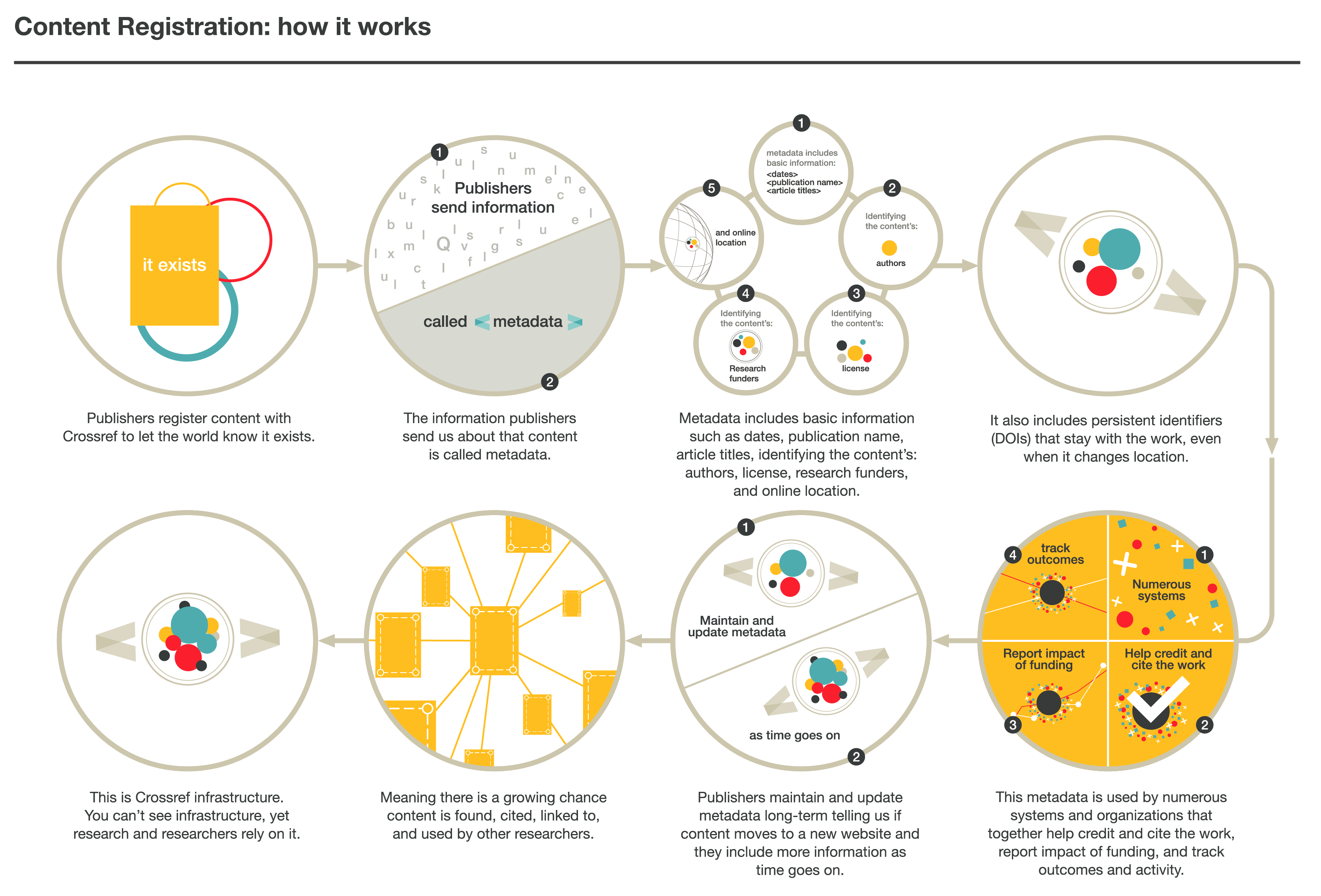
Academic and professional research travels further if it’s linked to the millions of other published papers. Crossref members register content with us to let the world know it exists, instead of creating thousands of bilateral agreements.
Members send information called metadata to us. Metadata includes fields like dates, titles, authors, affiliations, funders, and online location. Each metadata record includes a persistent identifier called a digital object identifier (DOI) that stays with the work even if it moves websites. Though the DOI doesn’t change, its associated metadata is kept up-to-date by the owner of the record.
Richer metadata makes content useful and easier to find. Through Crossref, members are distributing their metadata downstream, making it available to numerous systems and organisations that together help credit and cite the work, report impact of funding, track outcomes and activity, and more.
Members maintain and update metadata long-term, telling us if content moves to a new website, and they include more information as time goes on. This means that there is a growing chance that content is found, cited, linked to, included in assessment, and used by other researchers.
Participation Reports give a clear picture for anyone to see the metadata Crossref has. See for yourself where the gaps are, and what our members could improve upon. Understand best practice through seeing what others are doing, and learn how to level-up.
This is Crossref infrastructure. You can’t see infrastructure, yet research—and researchers all over the world—rely on it.
To register content with Crossref, you need to be a member. You’ll use one of our content registration methods to give us metadata about your content. Note that you don’t send us the content itself - you create a metadata record that links persistently (via a persistent identifier) to the content on your site or hosting platform. Learn more about metadata, constructing your DOIs, and ways to register your content.
You should assign Crossref DOIs to and register content for anything that is likely to be cited in the scholarly literature.
What types of resources and records can be registered with Crossref?
We are working to make our input schema more flexible so that almost any type of object can be registered and distributed openly through Crossref. At the moment, members tend to register the following:
Conference proceedings: information about a single conference and records for each conference paper/proceeding.
Datasets: includes database records or collections.
Dissertations: includes single dissertations and theses, but not collections.
Grants: includes both direct funding and other types of support such as the use of equipment and facilities.
Journals and articles: at the journal title and article level, and includes supplemental materials as components.
Peer reviews: any number of reviews, reports, or comments attached to any other work that has been registered with Crossref.
Pending publications: a temporary placeholder record with minimal metadata, often used for embargoed work where a DOI needs to be shared before the full content is made available online.
Preprints and posted content: includes preprints, eprints, working papers, reports, and other types of content that has been posted but not formally published.
You pay a one-time content registration fee for each content item you register with us. content registration fees are different for different types of content and sometimes include discounts for back-year material. You don’t pay to update an existing metadata record. It’s an obligation of membership that you maintain your metadata for the long term, including updating any URLs that change. In addition, we warmly encourage you to correct and add to your metadata, and there is no charge for redepositing (updating) existing metadata. Learn more about maintaining your metadata, and managing existing DOIs.
Your content registration fees are billed quarterly in arrears. This means you’ll usually receive a bill at the beginning of each quarter for the content you registered in the previous quarter. The only exception is if you’ve only registered a small number of DOIs.