On behalf of the Nominating Committee, I’m pleased to share the slate of candidates for the 2026 board election. Every active member organisation is invited to submit a ballot to elect the incoming board class.
We’re providing a summary of the board’s July 2026 meeting. The July board meeting is our only in-person meeting. The board gathers for two days of strategic thinking and long-range planning, as well as conducting annual board business. This year, we focused on allocating surplus funds we have on hand to invest in a three-year project to redesign the content system. In a related discussion, we decided to lower content registration fees starting in 2027 because we’ve had a demonstrated history of generating surpluses, exceeding what we need to run Crossref. We also discussed the board structure, as part of our regular review of stakeholder governance. And we conducted annual board business, such as approving the audited financial statements and reviewed our risk register and mitigation plans.
The resolutions are available on the dedicated section of our website, which also lists the members of the Board and offers further information about our governance.
We also managed to squeeze in watching a World Cup game over dinner.
Starting today, funder names deposited in Crossref metadata without an identifier will be matched to ROR IDs, to support an open and connected Research Nexus. Funding information is an increasingly important part of the scholarly record. The improved matching strategy supports researchers, funders, institutions, and meta-researchers, who rely on that information to understand how research is supported and what outcomes that support produces.
Strengthening Scholarly Publishing in Africa is a collaborative webinar series bringing together ASSAf, Crossref, DOAJ, EIFL, and PKP to share practical guidance, resources, and approaches for strengthening the publishing ecosystem in the region. This series responds to the growing interest in open access, digital publishing, stronger editorial practices, and greater visibility of research publishing across Africa. Each partner organisation has long experience of building that capacity in the area of their expertise. In this series, we’re coming together to offer a more holistic learning experience to the community of African publishers, putting different aspects of the publishing process in their broader context.
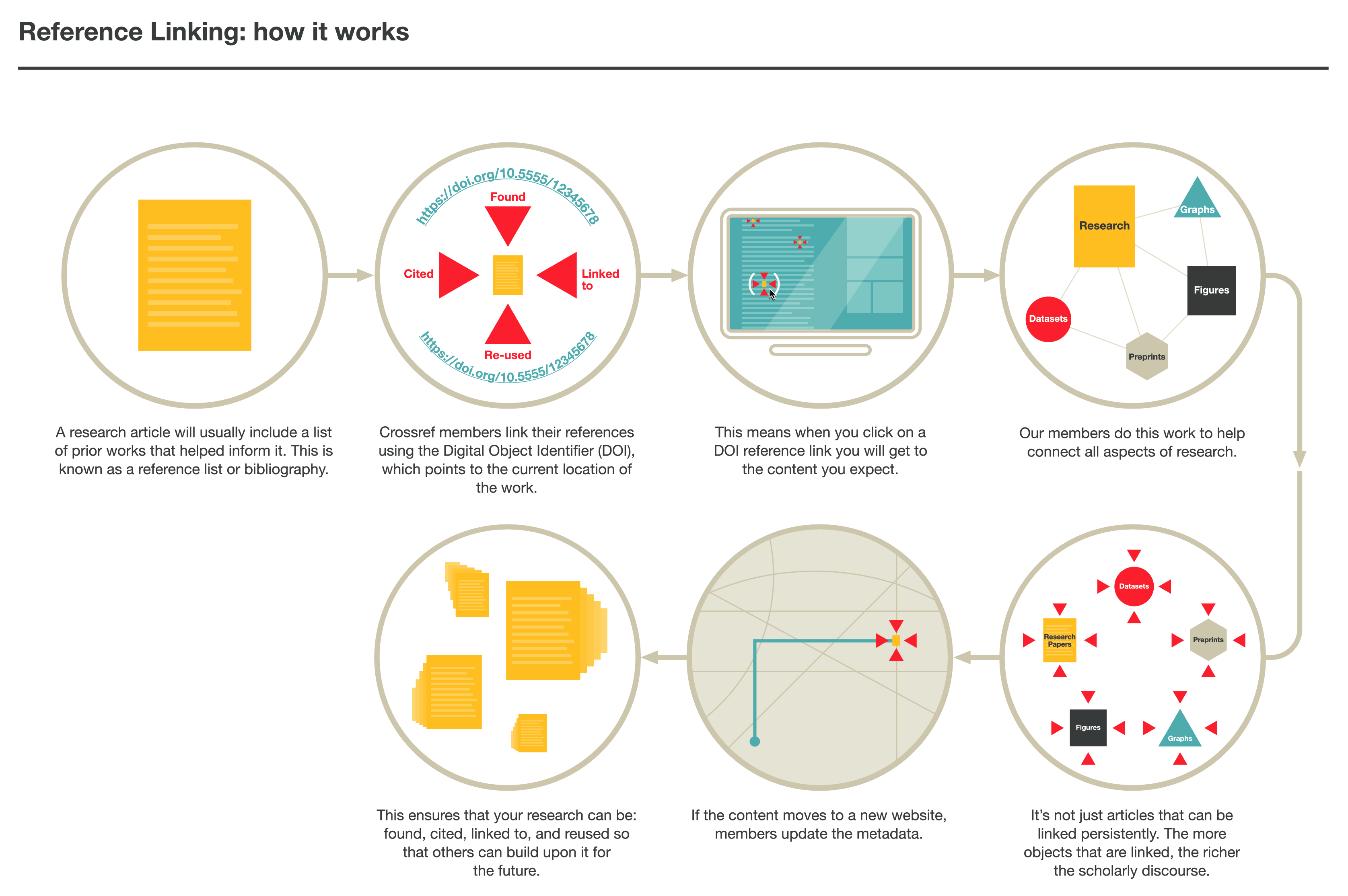
Reference linking enables researchers to follow a link from the reference list to other full-text documents, helping them to make connections and discover new things.
Reference Linking means including Crossref DOIs (displayed as URLs) in the reference lists that you provide in your own published work. This enables researchers to follow a link from a reference list to the current landing page for that referenced work. And because it’s a DOI rather than just a link, it will remain persistent.
So, instead of just including the reference in your reference list…
Soleimani N, Mohabati Mobarez A, Farhangi B. Cloning, expression and purification flagellar sheath adhesion of Helicobacter pylori in Escherichia coli host as a vaccination target. Clin Exp Vaccine Res. 2016 Jan;5(1):19-25.
…you should also display the DOI link:
Soleimani N, Mohabati Mobarez A, Farhangi B. Cloning, expression and purification flagellar sheath adhesion of Helicobacter pylori in Escherichia coli host as a vaccination target. Clin Exp Vaccine Res. 2016 Jan;5(1):19-25. https://doi.org/10.7774/cevr.2016.5.1.19
Because Crossref is all about rallying the scholarly community to work together, reference linking is an obligation for all Crossref members. But you don’t have to be a Crossref member to link your references - we provide free tools that anyone can use to match their reference lists to existing DOIs so they can link their references.
Watch the introductory reference linking animation in your language:
Persistent links enhance scholarly communications. Reference linking offers important benefits:
Reciprocity: members’ records are linked together and more discoverable because all members link their references.
As a member organisation, we can obligate all our members to link their references, so that individual members can avoid the inconvenience of signing bilateral agreements to link to persistent resources on other platforms. The result is a scholarly communications infrastructure that enables the exchange of ideas and knowledge.
Discoverability: research travels further when everyone links their references. Because DOIs don’t break if implemented correctly, they will always lead readers to the resource they’re looking for, including yours. When the DOIs are displayed, anyone can copy and share them. This will also enable better tracking of where and when people are talking about and sharing scholarly objects, including in social media.
Obligations and fees for reference linking
Reference Linking is an obligation of membership for all Crossref members. But anyone can use our support tools for Reference Linking - you don’t have to be a member. And there’s no charge to use our support tools for Reference Linking.
Getting started with reference linking
There are various different ways to look up other member’s DOIs to add to your reference lists. Read more here.