As we approach the end of 2026, research integrity remains a critical focus for the scholarly publishing ecosystem: fast technological advancements are constantly pushing the boundaries of integrity, impacting how everyone in this space interacts with the scholarly record.
Crossref members register around 37,000 records daily. All this metadata is openly shared with the global scholarly community through our free APIs. We receive over two billion calls to our API each month, signalling its use by hundreds of tools and services worldwide, supporting the discovery and assessment of scholarly metadata. As part of a new series in our blog, we will spotlight the diversity of tools and integrations that rely on Crossref metadata to serve the scholarly community. In this initial post, we chat to Luca Foppiano, the developer and maintainer of Grobid1, to learn about how Grobid uses Crossref metadata to improve the extraction and enrichment of bibliographic information from scholarly PDFs.
On behalf of the Nominating Committee, I’m pleased to share the slate of candidates for the 2026 board election. Every active member organisation is invited to submit a ballot to elect the incoming board class.
We’re providing a summary of the board’s July 2026 meeting. The July board meeting is our only in-person meeting. The board gathers for two days of strategic thinking and long-range planning, as well as conducting annual board business. This year, we focused on allocating surplus funds we have on hand to invest in a three-year project to redesign the content system. In a related discussion, we decided to lower content registration fees starting in 2027 because we’ve had a demonstrated history of generating surpluses, exceeding what we need to run Crossref. We also discussed the board structure, as part of our regular review of stakeholder governance. And we conducted annual board business, such as approving the audited financial statements and reviewed our risk register and mitigation plans.
The resolutions are available on the dedicated section of our website, which also lists the members of the Board and offers further information about our governance.
We also managed to squeeze in watching a World Cup game over dinner.
At Crossref, organisations that develop and manage technical tools for content registration can join our Service Providers Program. It’s a collaborative program where service providers work with us and with Crossref members to help fulfil member obligations and adopt best practices such as providing key metadata represented in Participation Reports. Members looking for advice on how to evaluate service providers can consult guidance on working with a service provider in our documentation.
Organisations eligible for the Service Providers Program include:
Hosting and publishing platforms
Manuscript submission systems
Grant management systems
Workflow and infrastructure providers
Note that the Service Providers Program is separate from the Sponsors Program, which is for organisations that make membership and participation in Crossref more accessible.
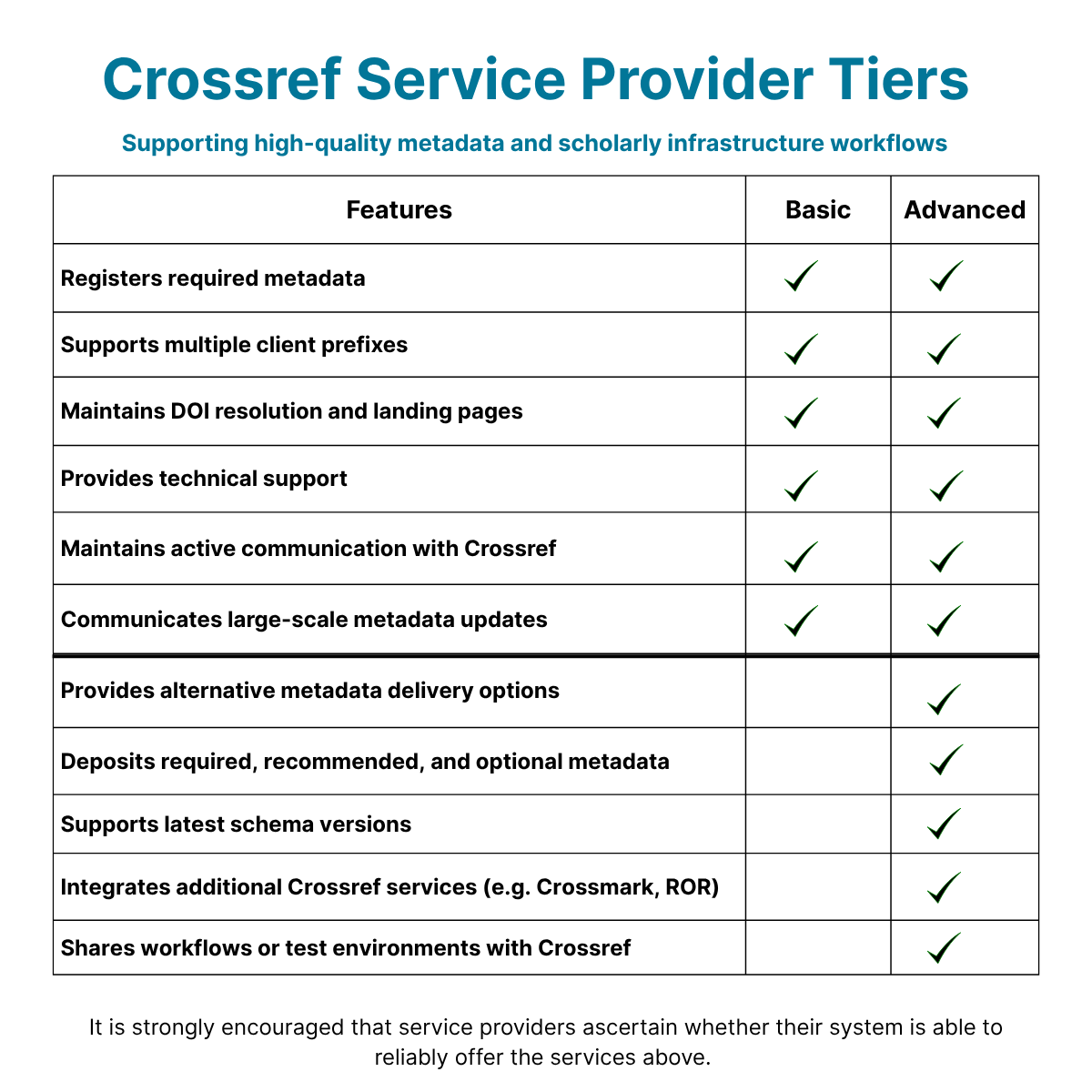
The Service Providers program is designed to support the registration and maintenance of high-quality and rich metadata, thereby contributing to a more connected and complete Research Nexus. To achieve this, we have developed two service provider tiers. The Basic tier reflects that participants in the program are able to provide members with core metadata support, while the Advanced tier includes participants who can provide all the capabilities of the Basic tier plus additional features that enable even richer metadata support for Crossref members.
Organisations participating in the Service Providers Program will be listed on our website and, in turn, will receive a badge to use on their website signalling their participation in our Service Providers Program. Your organisation will also receive advance communication about relevant Crossref updates and any changes to our schema. You will also receive access to our test systems for integration testing, and have opportunities to provide us with feedback on services, workflows and other developments.
Commitments
By participating in the program, participants will commit to making an effort to stay up to date with Crossref services and policies and share information about their client service offerings and workflows, including metadata delivery options. Similarly, participants will commit to creating and maintaining test accounts for Crossref to facilitate efficient member support.
It is expected that service providers on our program will promote metadata best practices as represented in our Participation Reports, ensure that their clients’ content and landing pages are maintained and actively resolving, and make reasonable efforts to accommodate services and schema changes.
The application and accreditation process
Applications to join the program are open and will be reviewed on a continuous basis. After completing the form below, you will be invited to an accreditation call which will involve demonstrations of the required functionality. This will help us assess which of the requirements your organisation is able to meet, and which tier would be most suitable.
We recommend reviewing the questions to ensure that the appropriate technical and operational requirements can be met before beginning the application. If you require clarification on any of these questions, please do not hesitate to reach out to us.
Maintain communication channels with Crossref and/or participate in trainings.
Notify Crossref when large-scale metadata updates are planned (i.e. when you are aware of daily updates exceeding 500,000 DOIs updated by a single client (Crossref member)).
Use Crossref members’ credentials to register content on their behalf.
Follow industry best practices for credentials security and account protection.
Advanced Tier requirements and questions
In addition to meeting all the Basic Tier requirements, applicants must confirm whether they:
Provide alternative metadata delivery options.
Support recommended and optional metadata elements.
Support latest schema versions (5.3.1 and above).
Each participant in the program will be required to renew their accreditation at the beginning of each calendar year starting in 2028. This will be done through the submission of a re-accreditation form which may include new requirements such as support for a new schema version. You are invited to complete the application form below to be considered for the program.