You can now register rich metadata for a variety of record types in Metadata Manager using simple, guided workflows. The tool is used by many in our community to register grant and journal article records, and it has now been expanded to support books and chapters, reports, dissertations, and post-publication updates for journal content.
Metadata Manager makes it easier to capture identifiers for contributors and their affiliations, funding information, references, and more. Thanks to automated reference matching by Crossref, this offers greater visibility for the works, while the affiliations and funding information can serve as important trust signals for the community.
This year’s edition of the FORCE11 conference was hosted in June by Singapore Management University. Its title, “To Go Far, Go Together: Advancing Scholarly Communication Across Boundaries and Disruptions” truly resonates with Crossref’s truths; it takes a village! Crossref only works as long as the scholarly research community wants to work together globally, across all disciplines, for integrity and openness of the scientific record. The conversations were influenced by a genuinely diverse mix of librarians, researchers, open infrastructures, and service providers, and that mix shaped almost every interaction we had at the conference.
We have some rather unusual news to share: Crossref fees are going down again. At its meeting in Paris earlier this month, the Crossref Board approved two further recommendations from the Resourcing Crossref for Future Sustainability (RCFS) project: effective 1st January 2027, we will reduce the majority of Content Registration fees for all 25,000 members, and remove fees for back-year records altogether.
Content Registration fees haven’t increased in around 20 years, and this is the first significant change to them in that time—downwards. Since these fees account for the largest share of Crossref’s revenue (around 60%), and since every member registers DOI records, these changes reach further than anything we’ve announced under the RCFS project so far.
The infrastructure that registers and distributes Crossref metadata has been running and growing for more than two decades. It now does considerably more than it was built to do, and it shows: two large, tightly coupled monoliths (Content System and REST API), where a change in one place risks breaking something in another.
In its July meeting, the Crossref board approved the use of Crossref surplus funds for a three-year project to accelerate the redesign of the Crossref system. Our plan is to use $1.6 million a year for three years (~USD $4.9M in total) from our surplus funds, which will help us set up a modern infrastructure consisting of separate services for the different functionalities that the Crossref system offers.
Test out the early preview of Event Data while we continue to develop it. Share your thoughts. And be warned: we may break a few eggs from time to time!
Chicken by anbileru adaleru from the The Noun Project
Want to discover which research works are being shared, liked and commented on? What about the number of times a scholarly item is referenced? Starting today, you can whet your appetite with an early preview of the forthcoming Crossref Event Data service. We invite you to start exploring the activity of DOIs as they permeate and interact with the world after publication.
But first, a bit of background
Discussion around scholarly research increasingly occurs online after publication, for example on blogs, sharing services, social media, and wikis. These ‘events’ occur across the web on numerous platforms and are a critical part of the scholarly enterprise. We are developing an infrastructure service (Crossref Event Data) that collects, stores, and delivers raw data of the events occurring with Crossref DOIs. We will store the data in an open, auditable and portable form for the community to access. Publishers, platforms, funders, bibliometricians and service providers may benefit from access to this raw data, and it can be used to feed into research records or proprietary tools and services that offer aggregation and analysis.
Developers Martin Fenner (DataCite) and Joe Wass (Crossref) enjoy a tofu break
Lagotto, the software originally developed at PLOS, has been extended and improved in a joint effort between DataCite and Crossref. The two DOI Registration Agencies have partnered to envision, build and release the service. On the 13th of April, after a year ofcollaboration, we jointly released Lagotto 5.0. You can read about the collaboration on the DataCite blog post.
Crossref and DataCite will continue to work closely together to develop Lagotto and the Event Data service. Although Crossref Event Data has mostly Crossref DOIs at launch, you will be able to find DataCite DOIs if they are cited in Crossref or Wikipedia.
All of the software that runs Event Data, including Lagotto, is developed in the open and is open source. Please refer to the Crossref Event Data Technical User Guide for full details.
Preview the data
This service is currently under development with a full launch expected the second half of 2016. Before it is launched however, we invite you to take a look around and preview a subset of the data sources we plan to include. You may experience occasional hiccups while we continue building the service.
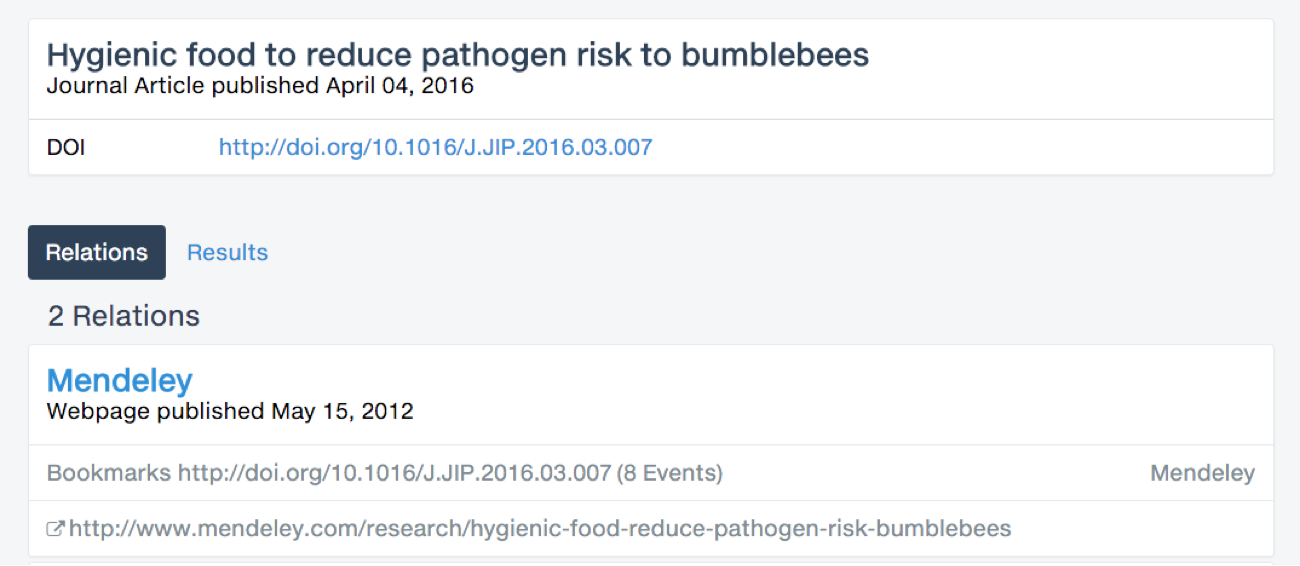
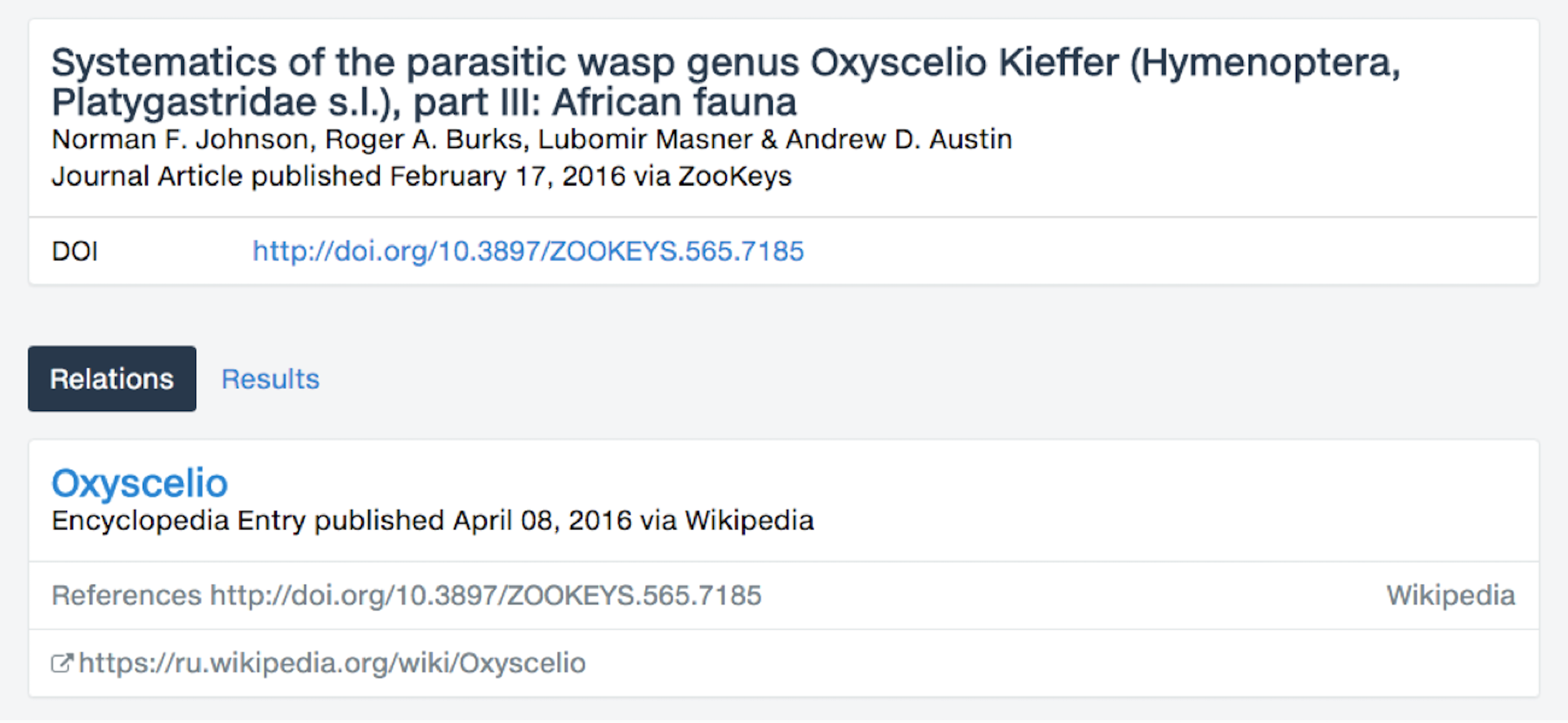
At this stage, we are working with data from three sources although we will greatly expand the variety of platforms from which we collect data as development progresses. At this stage, you can view Mendeley bookmarks, Wikipedia references, and Crossref to DataCite links.
Mendeley
Mendeley is a reference manager and academic social network for scholars. View the number of social bookmarks from scholars or groups on Mendeley.
Wikipedia is an online encyclopaedia, the Internet’s largest and most popular general reference work. View references in Wikipedia of Crossref publications in Wikipedia articles in all languages.
DataCite is a global consortium that assigns DOIs to research data. This enables people to find, share, use, and cite data. You can view all the data citations to DataCite research outputs found in Crossref publications (work is underway to make the links found in DataCite metadata available in Event Data).
You can explore the Crossref Event Data early preview by visiting http://eventdata.crossref.org and following the links to featured examples within our interim application for inspecting the data, technical documentation, and our Quick Start guide.
Share your thoughts
This service is currently under development and as such we welcome your thoughts and feedback on the data we are collecting currently from our three active sources. As a reminder, we expect to include the following sources as part of our full service launch later this year (pending confirmation):
[table id=1 /]
We’re also on the lookout for new data sources to investigate for future inclusion in the Event Data service so please do get in touch with requests and recommendations. As we continue to build the service throughout 2016, we will be committing to a model of continuous development so that we can make new sources available as they are completed.
Watch this blog for regular updates on our progress, or subscribe to receive new blog posts by email (just add your details to the upper right side of this page).