Blog

Rosa Morais Clark

Rosa Morais Clark

Rosa is the Communications and Events Manager at Crossref, where she leads external communications, oversees sponsorships, and creates content for different channels. She also plans events that help bring Crossref’s diverse community together and support its growth. With a background in admin management, Rosa is all about trying to encourage meaningful conversations and building connections. Outside of work, she loves good food, photography, and spending time with her family, friends, and dog.

Read more about Rosa Morais Clark on their team page.

Good infrastructure is patient work: #Crossref2026 highlights

Ed Pentz, our Executive Director, opened the 2026 Annual Meeting by introducing the theme: Good infrastructure is patient work. Crossref provides foundational infrastructure: an open, persistent scholarly record of metadata, relationships, and identifiers that thousands of tools and services build on. Maintaining that infrastructure and creating lasting value depends on sustained collective effort. True persistence requires active governance, long-term financial commitment, and organisational stewardship.


An updated look at Crossref’s carbon footprint - the 2025 report

In 2022, we committed to balancing our working practices and environmental impact, and to openly reporting on those efforts. This is our third report on Crossref’s annual carbon footprint and reflects as much our emissions as it does our learning process. Travel remains the main area of our environmental impact. In 2025, our total emissions were 170 tCO2e, a 3% increase from 2024, with travel accounting for 85% of the total. A big change this year is that we have greater visibility into our AWS-related emissions. With the full transition of our metadata registry and content registration system to the cloud and significantly increased API use, we’re seeing higher carbon costs to host and run our services.

Building, refining, and connecting: summary of our May 2026 community update

Our 2026 Community Update took place on 13 May. Two calls, one for the eastern and one for the western time zone, highlighted how our global community is growing, how we’re refining the metadata that supports trust in the scholarly record, and connecting records more effectively through our latest tools.

Twenty-five years of Crossref: reflections from the 2025 annual meeting and board election

Crossref turned twenty-five this year, and our 2025 Annual Meeting became more than a celebration—it was a shared moment to reflect on how far open scholarly infrastructure has come and where we, as a community, are heading next.

A second look at Crossref’s carbon footprint - the 2024 report

In 2022, we wrote a blog post “Rethinking staff travel, meetings, and events” outlining our new approach to staff travel, meetings, and events with the goal of not going back to ‘normal’ after the pandemic and said that in the future we would report on our efforts to balance online and virtual events, work life balance for staff, and track our carbon emissions. In December 2024, we wrote a blog post, “Summary of the environmental impact of Crossref,” that gave an overview of 2023 and provided the first report on our carbon emissions. Our report on 2023 only just made it into 2024, so we are happy to report on 2024 a little sooner in the year.

From storage closet to metadata champions: ASM’s journey toward a smarter scholarly infrastructure

The American Society for Microbiology (ASM) has earned recognition in Crossref’s Participation Reports for its exceptional metadata coverage among large publishing members––an achievement built on intentional change, technical investment, and collaborative work. In this Q&A, the ASM team shares what that journey looked like, the challenges they’ve tackled, and how centering metadata has helped them better connect research with the global scientific community.

Scholarly blogs and their place in the research nexus

If you are reading this blog on our website, you may have noticed that alongside each post we now list a Crossref DOI link, which was not the case a few months ago (though we have retroactively added DOIs to all older posts too). You can find the persistent link for this post right above this paragraph. Go on, click on it, we’ll wait.

Sprinting to Progress: Behind the scenes of our first metadata sprint

If you take a peek at our blog, you’ll notice that metadata and community are the most frequently used categories. This is not a coincidence – community is central to everything we do at Crossref. Our first-ever Metadata Sprint was a natural step in strengthening both. Cue fanfare!. And what better way of celebrating 25 years of Crossref?

We designed the Crossref Metadata Sprint as a relatively short event where people can form teams and tackle short problems. What kind of problems? While we expected many to involve coding, teams also explored documenting, translating, researching—anything that taps into our open, member-curated metadata. Our motivation behind this format was to create a space for networking, collaboration, and feedback, centered on co-creation using the scholarly metadata from our REST API, the Public Data File, and other sources.

A summary of our Annual Meeting

The Crossref2024 annual meeting gathered our community for a packed agenda of updates, demos, and lively discussions on advancing our shared goals. The day was filled with insights and energy, from practical demos of Crossref’s latest API features to community reflections on the Research Nexus initiative and the Board elections.

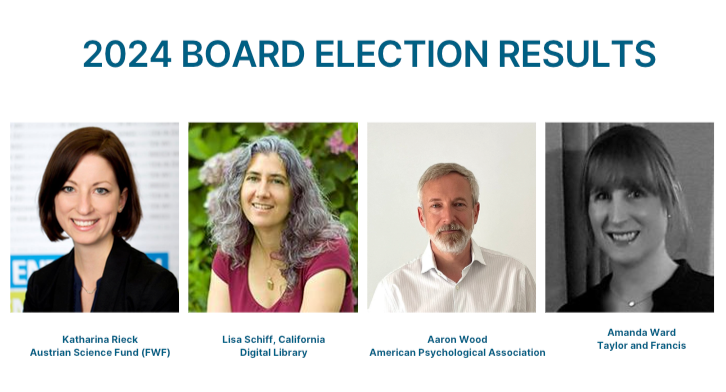
graphic with headshots of panelists

Our Board elections are always the focal point of the Annual Meeting. We want to start reflecting on the day by congratulating our newly elected board members: Katharina Rieck from Austrian Science Fund (FWF), Lisa Schiff from California Digital Library, Aaron Wood from American Psychological Association, and Amanda Ward from Taylor and Francis, who will officially join (and re-join) in January 2025. Their diverse expertise and perspectives will undoubtedly bring fresh insights to Crossref’s ongoing mission.

The meeting started with a recap of our mission and priorities. Ed Pentz reiterated the Research Nexus vision of increasing transparency of the connections that make up the scholarly record and underpin the research ecosystem.

Summary of the environmental impact of Crossref

In June 2022, we wrote a blog post “Rethinking staff travel, meetings, and events” outlining our new approach to staff travel, meetings, and events with the goal of not going back to ‘normal’ after the pandemic. We took into account three key areas:

  1. The environment and climate change
  2. Inclusion
  3. Work/life balance

We are aware that many of our members are also interested in minimizing their impacts on the environment, and we are overdue for an update on meeting our own commitments, so here goes our summary for the year 2023!